Search This Blog

Monday, 24 August 2020

Troublemaker. aka Black Sheep:James HARVEY & Susannah LUCAS

had initially thought that the prompt was Black Sheep. Because this story has been a troublesome one to write its sub title will be Black Sheep

This prompt could easily be applied to an ancestor that I have already written about.

So where do I start this time? Well there’s the great aunt who was cited for adultery. She isn’t a direct ancestor and all I know are the bare facts. Besides I don’t feel that it is my place to write about her. If she’d been my grandmother…well that would be different, but she wasn’t. Thinking about it, my family has quite a few ‘black sheep’, but show me a family that doesn’t.

So maybe I’ll write about ‘lost sheep’ instead.

Previously I wrote a story about a third great grandfather, James Harvey, in week 22, Uncertain when both James and his wife Susan Lucas were not in the same household on the 1841 census as their children.

James and Susannah marriage took place at Barking Tye, Suffolk, which is about 20 miles 23 km from Wilby.

Is it too much of a coincidence to discover on the 1841 census for Wilby, that Thomas Aldous who Susan goes on to marry on 11 February 1848, eight years after James died, lives right next door to a David Harvey and his family including a child called James and a daughter called Harriot, both of which seem to be family names. Interesting it maybe, but I cannot find a link, yet.

There is a possible James on the 1841 census, but in Worlingworth, Hoxne, which is only about three and a half miles from Wilby (about 3.5 Km), but no sign of Susannah  

On yet another Suffolk census, this time at Brandeston, about ten miles from Wilby is another James Harvey

I thought I was on to something with an 1841 census search for Susannah in Worlingworth which is about 25 miles from Wilby. When I looked at the actual record it was for a nine-year-old Susan Harvey. Again, is that too much of a coincidence to find Harvey in a family of Lucas’s?

The search for my troublesome ‘lost sheep’ is somewhat disheartening, but I do hope one day to be able to solve the mystery of where James and Susannah where on census night


Saturday, 8 August 2020

Small: John HALL & Martha WHYMENT

I have already written about those of my ancestors who appear in the few photographs I have of them, so I do not know if they were tall or small, and their families were definitely not small. So, what to write about for this week’s prompt?

I suppose the prompt could be about the small amount of information that I have about more distant ancestors such as William Hall’s parents, John Hall and Martha Whyment who were one of my maternal three times great grandparents. 

The only piece of evidence, as yet, that I have is a parish marriage entry

 I’ve learned from previous experience it’s important to unpick ALL the details on certificates.

John Hall was a widow when he married spinster Martha Whyment. They were married by banns at St Guthlac, Crowland. Witnessed on Tuesday 11 October 1796. Their witnesses, who signed their names rather than with an X, were Ann Ashby and Sheb Beckwith.His name appears on two other marriage entries so is unlikely to be a family member. As yet there has been no proven connection with Ann Ashby. Martha was described as a ‘sojourner’, which means that she was from a different parish. After many years of search, I have still not been able to locate any birth details for her.

I can find the births and deaths of two children born to John and Elizabeth Warren. William who was born in 1787 and died later that year and possibly Robert who has yet to be verified.

John and Martha had another nine children. Between 1797 and 1816.

Martha 1797–1826, William 1799–1804, Thomas 1801–1802, Charles 1802-1802, Sarah 1803–1809, William 1805–1880, Samuel 1807–1809, Elizabeth 1813- ? and Samuel 1816–1816  

Supposing that Marth’s age was twenty she married John in 1796 she would have been born c 1776, making her aged 40 when their last child Samuel was born.

According to another researcher, who had access to parish records, it is thought that John was born in 1763 and died c 1836,  Martha's birth and death dates are still being debated, but is is thought she died in 1826

So, there it is a small, the small amount of information that I have about John and Martha.


Sunday, 2 August 2020

Large: William HALL

It’s getting harder as the weeks go by, and my ancestors get further away, to write these stories. This week’s prompt is no exception. So, I went to my ‘large’ blue book, as mentioned in week 13, to check which of my ancestors was still waiting to be written about. A couple of weeks ago I wrote about Elizabeth Hinson, this time it’s her husband William Hall, a great great grandfather.

I don’t have an exact birthdate for him, but he was baptised 28 March 1805, St Mary, St Bartholomew and St Guthlac, Anglican Church. 

I had always thought that a baptism and christening were the same thing. But they are not, though these days the two terms are interchangeable, and happen at the same time. In the past a baptism was to ‘wash away sins’ while the baptism was a naming ceremony and a welcoming into the church. In the Church of England these ceremonies were usually on a Sunday. Interestingly in an emergency almost anyone could perform the baptism in order to save the soul. https://www.genuki.org.uk/big/eng/LIN/churchrecs#Baptisms

William and Elizabeth’s lives are documented in Elizabeth’s story, so I thought I’d write a bit about Peterborough and Crowland.

The first census William and his family appear on the 1841, which was ten years after the first infirmary had been built in the town. English census prior to 1841 only recorded the number of people in a dwelling but not the names. By 1851 the population was almost 9,000, going on to reach 17,000 in just twenty years.

Peterborough’s streets were lit with oil Lamps from 1795 which were replaced by gas lit ones in 1830.  A corn exchange, for the selling and buying of grain was built in 1846. The 19th century saw the establishment of an iron foundry and brick making works. A rapid increase in the population was driven by the arrival of the railway in 1845. Town improvements included piped water and sewage system were completed in 1880, and Peterborough’s first public library opened in 1892. 

William and Elizabeth’s lives are documented in Elizabeth’s story, so I thought I’d write a bit about Peterborough and Crowland.

The first census William and his family appear on the 1841, which was ten years after the first infirmary had been built in the town. English census prior to 1841 only recorded the number of people in a dwelling but not the names. By 1851 the population was almost 9,000, going on to reach 17,000 in just twenty years.

Peterborough’s streets were lit with oil Lamps from 1795 which were replaced by gas lit ones in 1830.  A corn exchange, for the selling and buying of grain was built in 1846. The 19th century saw the establishment of an iron foundry and brick making works. A rapid increase in the population was driven by the arrival of the railway in 1845. Town improvements included piped water and sewage system were completed in 1880, and Peterborough’s first public library opened in 1892.


Tuesday, 21 July 2020

The Old Country: POETRY

I wrote this poem some years ago as part of a Life Writing Course.
Sue was my best friend. We’d  talk about all sorts of things  She came from England and I'd always referred  to it as ‘Home’, after all Mum and Dad had called it that. I’d heard it called that all my life by all my rellies, and I thought it was the right way to refer to England. That was until one day Sue said to me “That’s not home, why are you calling it that? This is home, where you are right now” So I stopped calling it that, but I think in my heart of hearts I still felt as though it was. Years later my husband and I were able to go to England. As I stepped off the plane I remember being so disappointing. It was not the ‘home coming’ I had eagerly anticipated. It was just another country to visit. The key concept there was the change in my belief about myself. My parents and sister were English by birth, I’m not. I’m a New Zealander. This is my home

HOME
Whenever she spoke of England
Mum called it Home
I used to too.
Until my friend Sue said,
“But home is where you  are”
So I didn’t call it that
Anymore.

When I went to England
I expected it to feel like
I was coming home.
But when I stepped off the plane.
It was just another
Country.

I was pleased to leave.
To leave the crowded places.
To be returning to blue water
And Green fields
And Empty spaces.
Pleased to be going
Home.


Newsworthy: Georgian PIRRETT


I think my Nan was a bit of a mover and shaker. In her younger years, long before emigrating to New Zealand with her husband and my parents she was effectively a single parent. Granddad was a merchant seaman and spent months and months at sea, not unusual for those in their East End neighbourhood. Yes, he would have contributed to the household finances, but in an erratic way. Nan did domestic work, and according to my Aunt (her daughter) she also worked at the local pub, and raised her small family of three mostly on her own.
There’s nothing newsworthy about that, Nan’s newsworthy moment came later. In 1955 Nan wrote a letter to a local newspaper, probably the Hutt News. In the letter Nan expressed her outrage at Rev. R.F. Clements ‘attack from the pulpit concerning the press publishing an account of the Foster case’  
I remember a family story about Nan writing to local MP Walter Nash about the same case, but so far have not been able to prove it.
My Aunt provided me a copy of Nan’s letter to the newspaper, and with a bit of help from google I found an actual newspaper report.


Monday, 13 July 2020

Multiple: Elizabeth HINSON

If there were twins on my side of the family i t would be easy to write about multiples, but there aren’t any. The only double ups I have are with names. I’ve got multiple Georges, Williams, and Edwards, as well as a few Marys and Mary Ann’s and Susannahs.
As I’ve already written a story about one of my great great grandfathers for week six, called Talking About George, But Which One? It’s time I stepped over to the other side of Mum’s tree and wrote about someone from there.
That someone was a great great grandmother called Elizabeth Hinson who married William Hall. They had at least eight children, including my great grandfather Thomas Hall.
Elizabeth and William lived their entire lives in Crowland/Croyland, an ancient fenland town situated near the southern-most border of Lincolnshire. The name Crowland or Croyland, means soft land. During the 13th century the area was just a muddy swamp, until fenland drainage lowered the water table.
This modern-day map shows the location of Poor’s Lane which was later renamed Albion Street.
According to public records Elizabeth seems hardly to have existed at all between her baptism and her marriage to William Hall, both events occurring at St Mary, St Bartholomew and St Guthlac, Anglican Church
Elizabeth was baptised at on May 24th 1805. Her actual year of birth is unknown, but census records put it at 1804 – 1805. The population of Crownland in 1801 was just 1425. By the time Elizabeth married William Hall on October 31 1831 Crownland’s population had increased to just 2268.
When Queen Victoria came to the throne in 1837 and like almost all of my ancestors, more than half of the population of  England worked in the countryside.

The 1841 census is recognised by genealogists as the most useful one as it details the names of the house occupants rather than jus the number of souls at a particular dwelling. In the 1841 is Elizabeth, aged 35, and married to William Hall, with five children. The address is simply ‘Town Lane’ 
To the left of Elizabeth’s Husband’s entry is a double slash and a single slash to the left of the older William’s name. The end of each building is shown with two slashes '//' and the end of each household in a building is shown with one slash '/'.
I am unsure if the older William Hall,  is related as Elizabeth’s father in Law was called John    


1841 England Census for Elizabeth Hall, Lincolnshire, Crowland, ALL, District 3, 
Elizabeth’s younger brother William later married Susannah Cook who lived right next door
Elizabeth’s husband’s occupation like most of his neighbours was ‘ag lab’. The life of an ‘ag lab’ would have varied with the seasons, and with the crops grown. They wouldn’t necessarily have been employed by just one farmer, though some were. Elizabeth would probably have worked in the fields during busy times like harvest alongside her husband and other wives. Children too were expected to work, their wages often an important addition to what would likely have been a meagre lifestyle.

The idea that an agricultural revolution was the forerunner to the industrial revolution continues to be debated by some even today. Nevertheless, better agricultural knowledge and techniques improved the efficiency of food production necessary to feed England’s rapidly growing population: a fifty percent increase 1800 – 1801.   This efficiency in food production meant that there were less jobs for the ‘ag labs’ ultimately resulting in the increasing number of people migrating from rural to urban areas. Elizabeth and her husband though, remained in the same town up until their deaths, William’s in c1880 and Elizabeth’s in 1885.

1851 England Census for Elizabeth Hall, m Lincolnshire, Crowland, ALL, 8b. Birthplace for the entire family ‘Craylands’
Address is Poor House Lane. Even though the name of the street has changed all the neighbours, including the Cook Family, remain the same, which makes me think that it was a matter of just renaming the street rather than them all moving. I have yet to discover if there was a workhouse/poorhouse close by before the new Union Workhouse was built in 1836 on the north side of Thorpe Road, workhouses were closed in 1930. I am waiting for a copy of a book called ‘In the Shadow of the Abbey’, which I am told has a section on Poors Lane which may answer the question. Crownland’s population in 1851 had now increased from 2268 to 3183. 
1861 England Census for Elizabeth Hall, Lincolnshire, Crowland, ALL, District 2In 1861 the family continued to live in Poors Lane, at number 5, as do their immediate neighbours the Cook Family, including Susannah, William’s future bride. They married October 24th 1870. Elizabeth’s husband’s occupation remained ‘ag lab’, no occupation was listed for Elizabeth as was common for the time, and son Thomas was a basket maker. Elizabeth may well have been occupied in milking and cheese and butter production or perhaps was employed in some domestic role. It is frustrating not to be able to be at least to have least a little knowledge about her life.
It is interesting to note that there now a family of Hinsons a little further along the street, at this stage I do not know if the family is related.

Moving forward another ten years to the 1871 census I find just William and Elizabeth at home at Poors lane with the Cook family still their neighbours. This time Elizabeth’s brother William is there too with his wife Susannah. Elizabeth’s husband still describes himself as an ‘ag lab’ at age 67. Crownland’s population had declined slightly to  3168, probably an indicator of the forthcoming Great Depression of British Agriculture 1873 -1896. In the 1870s faster steamships transported cheaper American grain leading to a dramatic fall in the price of domestically grown grain. It is no wonder then that many thousands succumbed to the lure of work in the cities.
1871 England Census for Elizabeth Hall, Lincolnshire, Crowland, ALL, 2

1881 England Census for Elizabeth Hall, Lincolnshire, Crowland, ALL, District 2. There had been a slight increase in population to almost three thousand.

Another ten year on and the census address is still Poors Lane are living the now widowed Elizabeth with her widowed daughter Elizabeth. William died in 1880. The daughter’s occupation was Nurse SMS (Subsidiary Medical Services). SMS may mean that she had some medical training, but it could just as likely be by custom/practice.  
Elizabeth died in 1885 aged 81 

Notes about Crowland today


The town has a variety of Georgian, timber-framed and thatched cottages. There are also some interesting archaeological and historical sights, the most famous of which is the ruined abbey. The abbey was part of Benedictine monastery, built in AD 716 by King Ethelbald of Mercia, to honour the memory of St Guthlac. Most of the monastic buildings were lost during the Dissolution and the English Civil War. Apart from the north aisle, which is now used as the parish church. A squat tower and ruined Norman arch still remain, supporting a superb west front, with five tiers of statues, representing the saints and apostles. The Abbey was destroyed and rebuilt several times, until it was finally decimated by Cromwell's troops it in 1643. Hereward the Wake is believed to be buried here with his family.
The Abbey Church holds a popular Flower Festival every August Bank Holiday.

An extraordinary three-way bridge sits in the centre of the town, built in the 14th-c over the confluence of two streams, which have long since dried up due to fenland drainage. A weathered stone figure on one of the bridge parapets is thought to represent either Christ or King Ethelbald.
 You can find a modern day guid to the town at
and a guide to the Abbey at


Friday, 26 June 2020

Middle: Susan CROKER


 The further into this challenge I get the more difficult it is to decide which ancestor to write about. The prompt Middle is so well…. Middling. 
So I went to the middle page of my ‘Blue Book’, the one I wrote about in week thirteen ,and looked for those ancestors I hadn’t yet written about. I didn’t quite close my eyes and stab a pin into an entry, but it was pretty close to that. And who have I chosen?
Susan Crocker who was one of my maternal great great grandmothers. She was the fifth child of twelve children born to Thomas Crocker and his wife Catherine Shinick, both Irish born. Though I do not know why or when they left Ireland but they had been living in Gloucestershire, England at least since the birth of their first recorded child in 1831.Susan  was baptised on a Sunday.
Roman Catholic.  Colston Avenue, St Mary-on-the-Quay. Baptisms 1828-1840
Born 01/08/1836 Baptised 07/08/1836


Baptisms for other Crocker children


St Mary-on-the-Quay is a Roman Catholic church (Diocese of Clifton) and was completed in 1840. The architect was Richard Shackleton Pope. The River Frome flows in front of the church but was covered over in 1893.

St Philip and St Jacob Church is considered to be the oldest continually worshiping church in Bristol; there has been Christian worship on the site since 980 A.D.)
Date: Circa 1920s; Photographer: Unknown; Publisher: Haywards, 1 Corn Street, Bristol.
On the 1841 census is Susan aged 6 living with her parents and four siblings at ‘Narrow Plain’ in the parish of St Philip and St Jacob, Gloucestershire. !841 was the year that the rail line between Bristol and London was completed.  
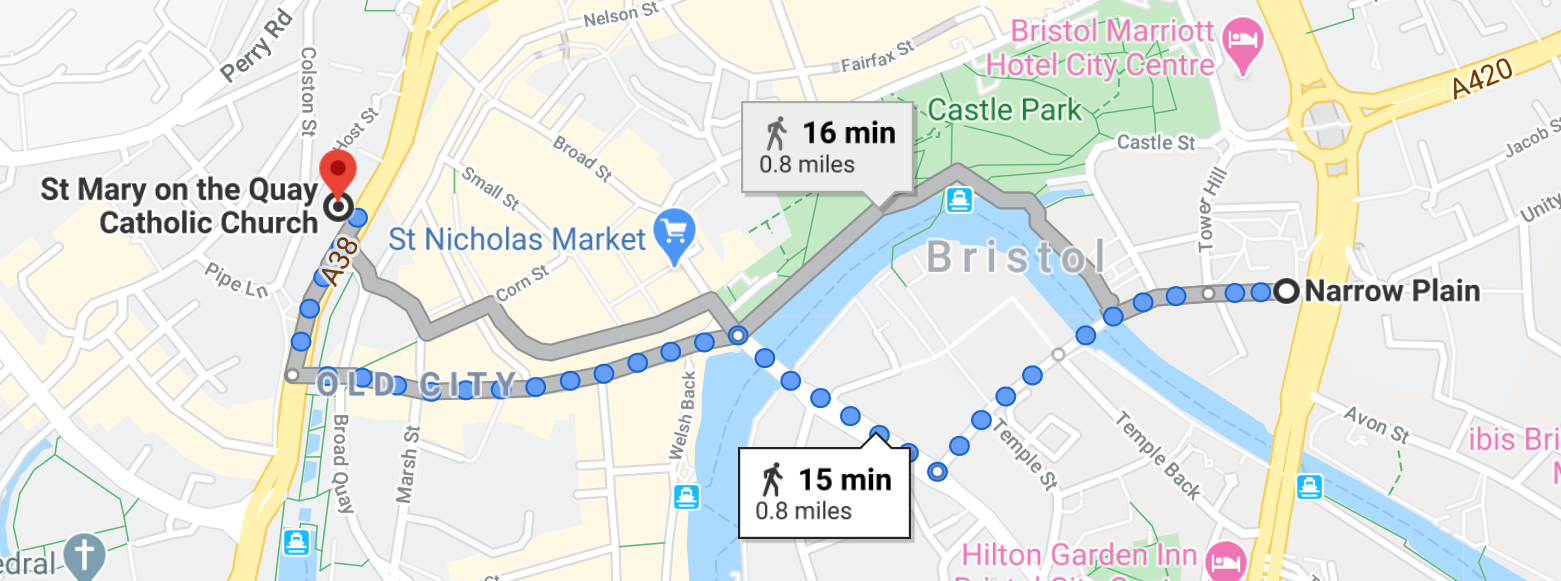
 The street called Narrow Plain exists today as does the Church of St Mary-on-the-Quay just a fifteen-minute walk away from Narrow Plain.


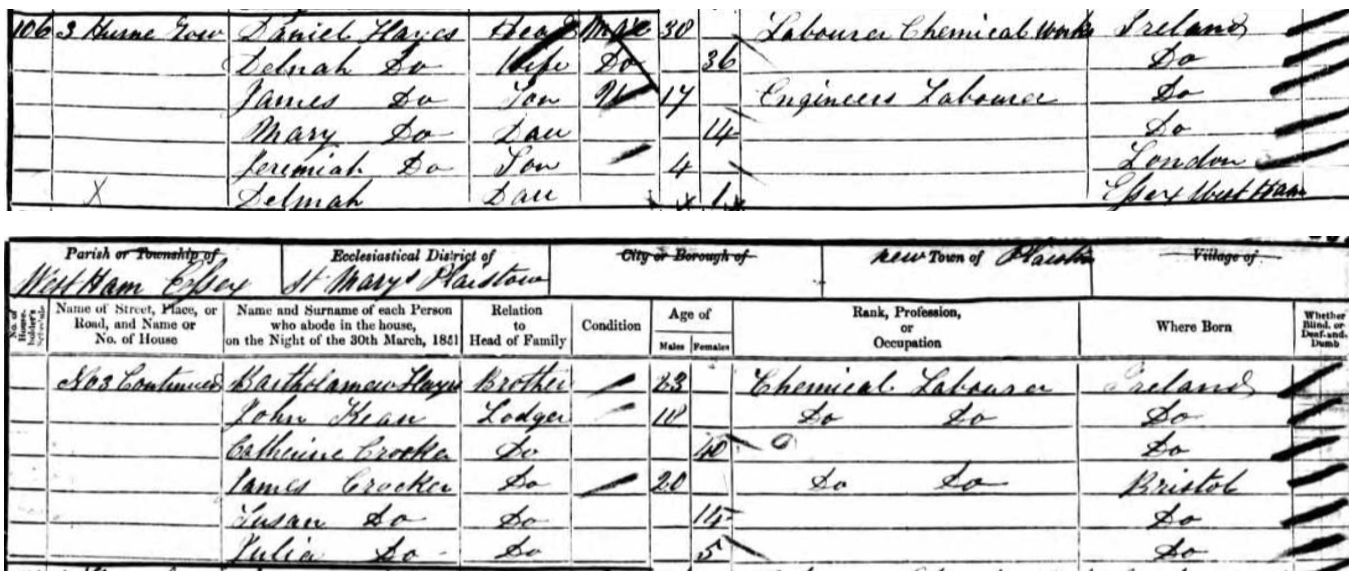
By the time of the 1851 census, Susan now aged 15, along with her mother Catherine, and three of her siblings are lodgers in what must have been a crowded household at number 3 Hume Row, Plaistow.  The large number of people living in what was likely to be a relatively small terraced house was by no means unusual for the time.  
Bear with me while I try to explain the connection. Head of the house Daniel Hayes was married to Debrah, who was Catherine’s sister. At this stage I have no idea where her husband Thomas or son Richard were. The only possible death for a Thomas Crocker is in the last quarter of 1851. The census that year was in March. The research to check that out will be done when I write about Thomas.

 Their living conditions would have been awful 12 people crammed into what was very likely a small terraced house that was unlikely to have had running water. At the time the nearby Thames was a stinking open sewer and with horse drawn transport crowding the streets the roads in and around London would have been awash with horse poo and urine. The combination of that alongside the foul-smelling chemical works would have been almost intolerable. It is no wonder that there were frequent outbreaks of typhoid and cholera.
 By the time of the next census in 1861 Susan had married Irish born Andrew Dwyer and you can read about them both at https://they-are-my-kin.blogspot.com/search/label/DWYER%20Andrew%20c1837%20-%201895
Her date of death is as yet unknown, but I do know that it was  it was after the 1901 census when she would have been 68 years old.